
GHG Protocol Scope 3Categories
The GHG Protocol Scope 3 Standard defines 15 categories of indirect emissions across an organisation’s value chain. These categories are designed to be assessed based on relevance and materiality, not automatically included in full.
The 15 Scope 3 categories are:
| Upstream categories | Downstream categories |
|
9. Downstream transportation and distribution 10. Processing of sold products 11. Use of sold products 12. End of life treatment of sold products 13. Downstream leased assets 14. Franchises 15. Investments |
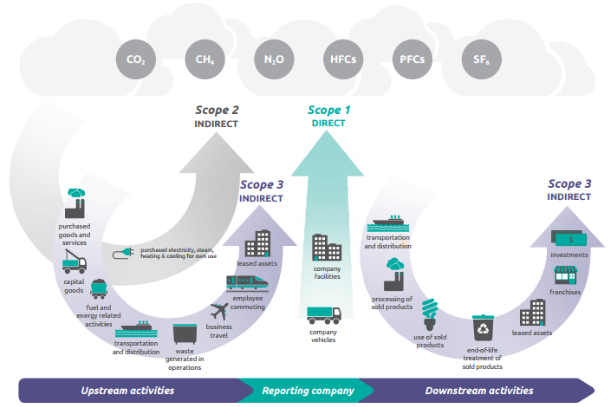
Materiality and relevance
For many companies, the upstream Scope 3 categories covered in Trace account for around 85 to 90 percent of total Scope 3 emissions. This aligns with leading practice under the GHG Protocol, where organisations are expected to prioritise material categories rather than report all 15 by default.
In practice, most organisations report on a subset of material Scope 3 categories, commonly six to eight. The remaining categories are often immaterial, highly assumption driven, or difficult to estimate in a way that meaningfully improves accuracy or insight. This is especially true for downstream categories, which depend heavily on product use profiles, customer behaviour, and end of life assumptions.
The GHG Protocol Scope 3 Standard explicitly allows Scope 3 categories to be excluded based on a relevance test. A category may be excluded where it is not relevant to the business based on criteria such as:
-
The category is not expected to contribute significantly to total Scope 3 emissions
-
The company does not have influence over the emissions source
-
Reliable data is not available or the estimate would be overly speculative
-
Inclusion would not materially improve the accuracy or usefulness of the inventory
Downstream categories often meet one or more of these criteria, which is why they are not included by default.
Trace software categories
By default, the Trace platform captures activity data for Scope 3 categories 1 to 8. These upstream categories are generally more standardised and can be calculated consistently across organisations using common data sources.
Downstream categories, by contrast, are highly bespoke and depend on product use profiles, customer behaviour, and end of life assumptions that vary significantly by business model. For this reason, downstream emissions are not captured by default within the Trace App.
Trace Consulting Services
Trace can support inventories across all 15 Scope 3 categories on request. Where downstream emissions are estimated through a consulting engagement:
-
The results can be imported into your Trace inventory
-
The methodology and assumptions are clearly documented
-
The inventory remains complete, auditable, and aligned with GHG Protocol expectations
This approach ensures your Scope 3 footprint is robust, defensible, and proportionate, without unnecessary complexity.
Please get in touch to discuss a consulting engagement to calculate your downstream emissions.