
Alignment With Reporting Standards
Trace’s Climate Risk Assessment (CRA) methodology is aligned to AASB S2 (Australian Sustainability Reporting Standards). This ensures outputs are suitable for regulatory reporting and board-level disclosure.
Specifically Trace CRA complies with the following disclosure requirements from the AASB S2 standard:
-
9(a) the climate-related risks and opportunities that could reasonably be expected to affect the entity’s prospects
-
9(b) the current and anticipated effects of those climate-related risks and opportunities on the entity’s business model and value chain (see paragraph 13);
-
9(c) the effects of those climate-related risks and opportunities on the entity’s strategy and decision-making, including information about its climate-related transition plan (see paragraph 14);
-
9(d) the effects of those climate-related risks and opportunities on the entity’s financial position, financial performance and cash flows for the reporting period, and their anticipated effects on the entity’s financial position, financial performance and cash flows over the short, medium and long term, taking into consideration how those climate-related risks and opportunities have been factored into the entity’s financial planning (see paragraphs 15–21); and
-
9(e) the climate resilience of the entity’s strategy and its business model to climate-related changes, developments and uncertainties, taking into consideration the entity’s identified climate-related risks and opportunities (see paragraph 22).
Types of Climate Risks Assessed
Trace assesses both major categories of climate risk:
A. Physical Risks |
B. Transition Risks |
|
Direct impacts from climate hazards, including: • Extreme heat Both acute events and chronic long-term shifts are assessed. |
Risks arising from the shift to a low-carbon economy, including: • Policy and legal risks This ensures businesses assess regulatory exposure, cost pressures, demand shifts, and brand implications. |
Scenario-Based Approach
Trace uses internationally recognised climate scenarios from the Network for Greening the Financial System (NGFS).
Two core scenarios are tested:
1.5°C Scenario |
2.3°C Scenario |
|
Orderly transition |
Fragmented World or disorderly transition |
This allows organisations to test resilience under both lower-risk and higher-risk futures.
Time Horizons Assessed
Trace evaluates risks across multiple timeframes, aligned to requirements under AASB S2 and ISSB, which require forward-looking analysis.
• Current reporting period
• Upcoming reporting period
• Medium term, typically 2030
• Long term, typically 2040
Data Sources and Inputs
Trace combines robust and scientifically backed third party climate datasets with internal business inputs.
External resources considered |
Client-specific inputs required |
|
Risk Scoring Method
Each material climate risk is assessed using the organisation’s existing Risk Management Framework scoring criteria, typically across two criteria:
-
Likelihood reflects the probability that the risk will occur within the defined time horizon.
-
Impact reflects the severity of the consequence if the risk occurs, including potential financial, operational or strategic effects.
Each risk is assigned a likelihood score and an impact score, typically on a 1 to 5 scale. These two scores are then combined using the company’s standard risk matrix to determine an overall risk rating ranging from Very Low to Very High.
Heatmaps are used to compare exposure across scenarios and timeframes, improving board-level usability.
8. Outputs Delivered
Trace provides outputs designed to support AASB S2 and ISSB disclosure, Board reporting, Risk register integration and Strategic planning.
Deliverables and activities depend on the approach selected: Minimum Viable Compliance or Best Practice.
To learn more about Minimum Viable compliance and Trace's two approaches to ASRS preparation, read this article.
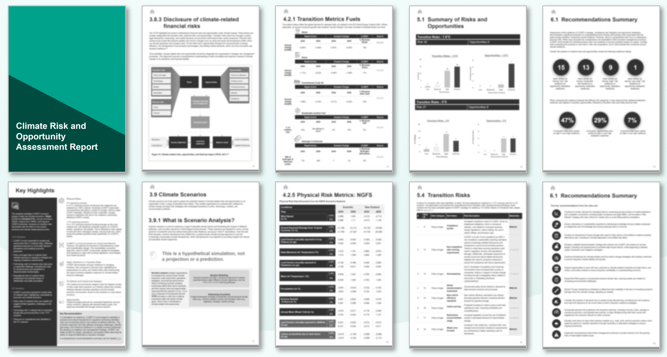
ILLUSTRATIVE REPORT OUTPUTS:
EXAMPLE RISK HEATMAP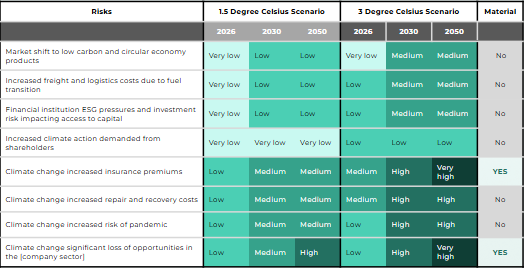
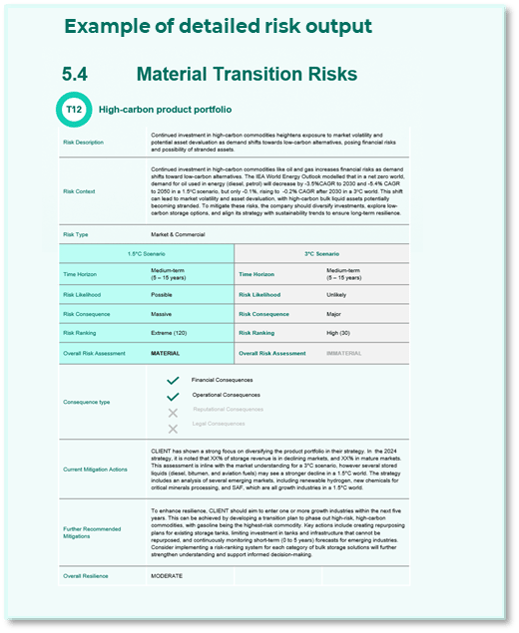
DETAILED RISK ASSESSMENT
Maturity Pathway: Qualitative to Quantitative
Trace follows a staged maturity approach aligned to our 'Minimum Viable Compliance' approach.
Year 1: Qualitative Baseline |
Year 2 and Beyond: Quantitative Enhancement |
This establishes a defensible baseline and supports initial regulatory compliance. |
Organisations may progress to: • Site-specific physical hazard modelling This enables more precise financial disclosure and capital planning over time. |
Why This Approach Works
Trace’s climate risk analysis:
✅ Aligns with global and Australian reporting standards
✅Uses credible international scenarios
✅Incorporates both science and operational insight
✅ Covers both physical and transition risks
✅Supports board-level decision making
✅ Builds capability over time
The result is a practical, defensible climate risk framework that supports immediate reporting needs while creating a foundation for long-term resilience and strategic advantage.
To learn more about Trace's climate risk analysis approach and pricing, please contact sales@our-trace.com.